
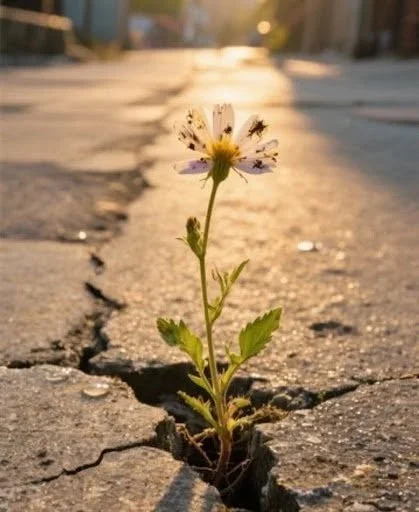
The Orchid and the Weed
Fellow helpers, have you ever stopped to ask yourself whether you are an orchid or a weed? It changed everything for me when I finally did.
Those of us who went into medicine, social work, emergency response, teaching, veterinary care, dentistry, or any of the other helping professions were never really taught to call uncle. We are wired to look outward, to show up, to push through, and the cultures we trained in rewarded exactly that.
Ask any helper how often they field calls from friends and family asking for advice, emotional, logistical, practical, and everything in between, and they will all laugh the same tired laugh, because the answer is always yes, and we almost never say no. I get at least one medical question a week. We are not just answering the calls either, we are quietly social working every situation, every room we walk into, every gathering, every conversation where someone looks a little off and we cannot help but notice and lean in. Helping is so deeply baked into who we are that the line between our work self and our off-duty self possibly stopped being clear a long time ago.
If you are a helper and spend your days pouring into others, this probably rings very true for you. We all went in wanting to do right by the people we serve, and somewhere along the way that became a quiet habit of putting ourselves second, third, or not at all. I only learned to finally slow down because my body made me, when I became very ill in early 2025 and the autoimmune storm that had been quietly building for years finally declared itself loudly enough that I could not ignore it. Before that I had always been an orchid trying to pretend to be a weed, keep reading and that comment will make sense.
I was in a session with my therapist and I said I used to be able to keep up with the pace. She looked at me and said, could you? I said yes, I was always doing it. She said, should you have been? I stopped in my tracks. When I looked back honestly I could see all the times I had been barely holding it together, working through severe neck pain and headaches from a neck that had been quietly losing cartilage in my facet joints for years, from an undiagnosed autoimmune condition, made worse by too many hours at a work screen.
I had been managing and minimizing for years, putting everything I had into being a good provider for the patients I see and the clinic I have worked for for twenty-four years. It was only when my body truly stopped me that I reevaluated what sustainable actually looks like. I still deeply love what I do as a physician assistant, I still love the patients I see and the clinic I get to work for that is filled with the most amazing staff.
The work itself is not the problem. Working in broken systems while ignoring your own signals until your body stages a revolt is the problem, and none of us were ever taught to put ourselves first. This is me asking you to.
I want to tell you about the day a patient handed me a piece of myself I had not known was missing. I was in a patient room and she looked at me and said I am just an orchid. If I do not drink enough, pee enough, eat enough, sleep enough, get enough love, I fall apart. I looked at her and said oh wow I am an orchid too. We laughed, and then I walked out into the clinic and started looking at my colleagues differently. Some of them are weeds. I went to my co-workers, you know the ones, they do not seem to eat, they do not seem to pee, they run from room to room all day without stopping and somehow they appear fine. I always wished I was a weed. I tried to keep up. I pushed past what my body was telling me for most of my career to try to match their pace, or I should say the pace that working in medicine, and likely in most of the helping professions, truly demands of all of us.
Here is what I understand now. The weeds are not making orchids feel inadequate on purpose. They set and can keep up with a pace that is simply impossible for an orchid to sustain. The orchids, not wanting to be seen as less capable, push past what their bodies are asking for, over and over, until the body makes the decision for them.
The thing about weeds is that even Roundup can kill a weed eventually. The stress, the overwork, the chronic dysregulation, the years of ignoring so many of the signals the body sends, working as a helper of any kind means your nervous system is likely swimming in glyphosate. The pace, the moral injury, the vicarious trauma, did I mention the pace.
Weeds might be hardier and it might take longer, but I fear when it is the weeds turn it may be more dire than the orchids who knew their limits and slowed down sooner. Burnout is real for everyone. The weeds are going to start burning out too. Many of them just do not know it yet, because their coping mechanism is to go faster, until they cannot. There is no shame in calling uncle. In fact, calling uncle might be the most courageous thing a weed has ever done, because it goes against every instinct that got them this far. If you are a weed reading this and something in you is quietly recognizing itself, that quiet recognition is worth paying attention to. You are allowed to matter too.
I was always the orchid who had to stop. Had to breathe. Had to fall apart a little, pull herself back together, and get back in the game. I used to be ashamed of that. Now I understand it was my body being honest with me. I am learning to listen.
Whether you are an orchid or a weed, please slow it down as much as humanly possible. Pay attention to your body. Check in on your burnout level and actual capacity before you say yes to one more thing. No more shoulding all over yourself. We need you. All of you. And we need you whole.
Not sure where your current capacity is.
A useful tool for understanding your capacity and how to grow it is the Window of Tolerance. I have included a handout below. The wider your window, the more you can hold without tipping into fight, flight, or shutdown. The work of healing and widening the window can happen in many ways, whether that is therapy, somatic practices, EMDR, hypnotherapy, massage and body work, music and meditation, medicine or ketamine journeys, or simply rest. All paths to healing are valid.
After doing several years of my own personal trauma work using many different modalities my window of tolerance is so much wider. So it is possible, I am proof of that. My dad's favorite saying was perseverance furthers. I spent most of my career trying to be a weed because I thought that was what perseverance looked like. What I know now is that perseverance needs to look different for an orchid. It looks like learning, slowly and sometimes painfully, to give yourself what you need to keep blooming. I am somewhere in the middle now, still rooted in concrete, but finally turning toward the light.
_______________________________________________
A balanced nervous system is what truly matters and this is what I wish for you